Tidewater Pottery Studio, version 1
- 1Class list
- 2Class details
- 3Choose a seat
- 4Pay
- ✓Confirmed
When something goes wrong
- !Payment fails
- Back to checkout, reason shown
- ↻Seat held for 15 minutes
Answer plain-English questions in Claude, get six documents and a PDF.

About an hour, one question at a time. Works for websites, portals, apps and SaaS.
Halfway through, someone picks a payment provider or a database nobody agreed to, and the price changes.
“A booking page” means one thing to you and another to the person quoting it. Six months later you find out which.
Who can see what gets decided by accident, usually after something has already gone wrong.
Your job is the reading and the deciding. The drafting, the structure and the cross-checking are handled for you.
Tell Claude what you want to plan. It asks one question at a time and shows an example answer under each.
You sayI want to plan a website before I build it.
Stuck on a question? Ask for a suggestion and edit it. Each document builds on the ones before it.
You saySuggest.
Everything arrives as a letter-size deck with your logo and name on it. Ask for changes until it is right.
You sayChange Doc 2: we use Square, not Stripe.
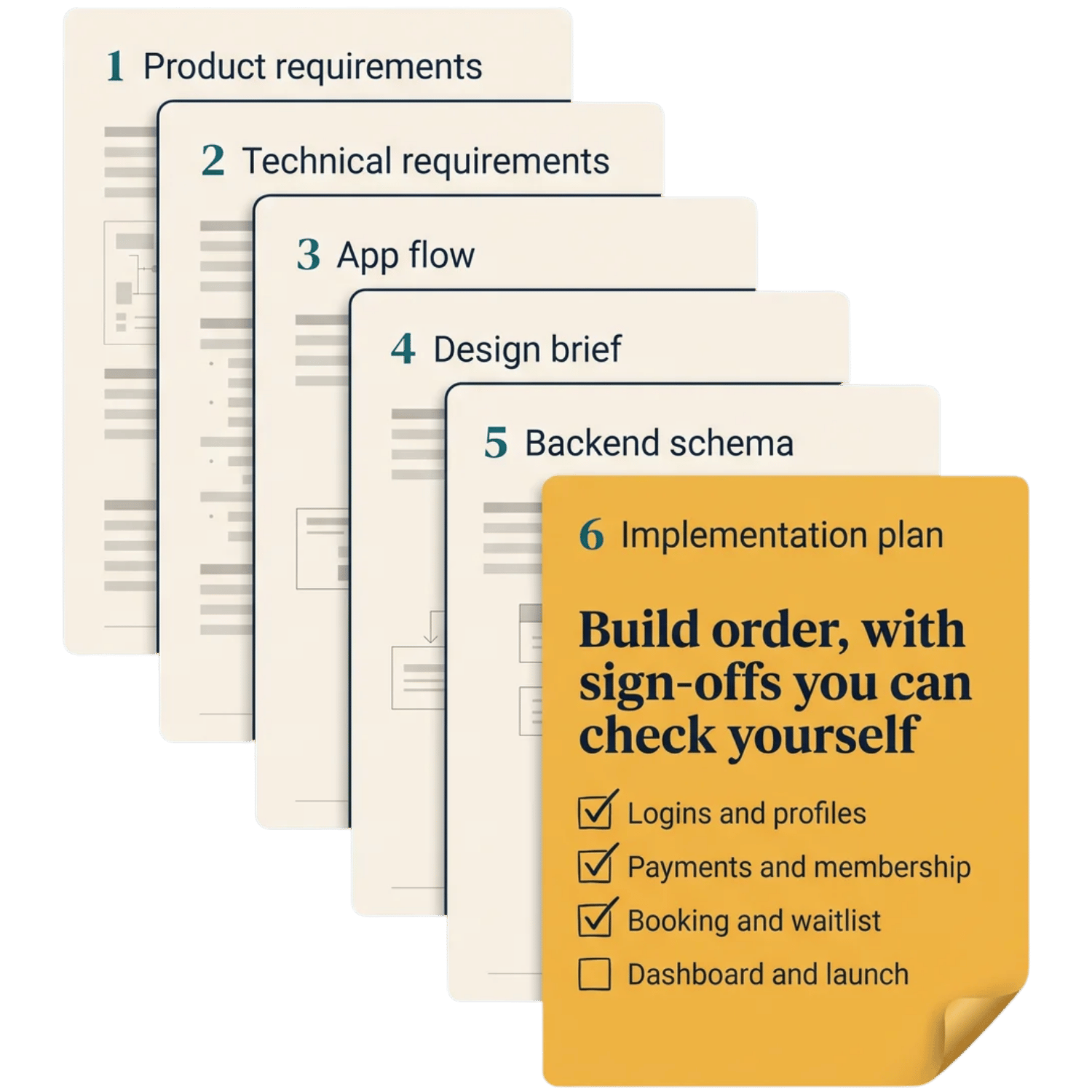
Hand the PDF to your freelancer, agency, team or AI coding tool, and sign off stage by stage.
You sayApproved.
A claim only counts if you can check it. Every document ends with a short check for you to run before you approve it.
Tidewater Pottery Studio, version 1
When something goes wrong
A page from the sample plan that ships with the kit, for an invented pottery studio.
The same six documents at every step. What changes is how much of the work you do yourself.
On your own
For people comfortable running one command in a terminal with Claude Code.
No terminal
Best for non-technical teamsRuns inside Claude. Add it as a Claude Project or upload it as a Skill, then start a chat.
With an expert
Felipe Suarez has delivered web and e-commerce projects for global companies for over 15 years. Bring him in at the point you need him.
A short form first, so the call starts prepared.
Felipe Suarez spent years as the project manager between the people who wanted something built and the people building it. The projects that went well started with the same thing: someone had written down what was being built, how it worked and who could see what.
The Plan-First Kit turns that habit into a guided conversation, so you can do it yourself, or bring him in when the stakes are high. felipesuarez.com
No. Every question is in plain English and comes with an example answer. If you get stuck, ask Claude to suggest something and edit it.
No. It produces the six documents your builder needs before they start. Hand the PDF to a freelancer, an agency, your own team or an AI coding tool.
The same six documents come out of both. The free GitHub kit runs in Claude Code on your computer and needs a terminal. The Project and Skill Edition runs inside Claude with nothing to install, and includes a setup guide.
A Claude account. The Project and Skill Edition needs a plan that includes Projects or Skills, so check Anthropic’s site for the current options. Claude is not included with the kit.
Yes. Book a call for a plan review, a planning sprint where Felipe runs the interviews with your team, or a managed project where he plans, builds and manages it for you.
Planning needs no passwords, card numbers or customer data, so never paste them into the chat. The kit asks about what you will store and who should see it, but it is not legal advice. For anything regulated, check with a professional.
Short, practical lessons on planning websites, portals and apps without the jargon. Unsubscribe any time.
Start with the free kit, or get the no-terminal edition. If the project matters, bring in someone who has done this for years.